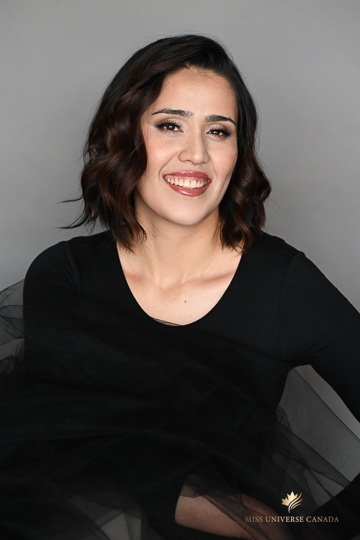
Bahar Zendagi
Hometown: Scarborough, ON
Occupation: Founder of A.I.R. (Atifa Institute of Research and Philosophy for Rare Sleep Disorders)
Bahar was born in Afghanistan, and her childhood was shaped by transitions between cities and countries. Each environment revealed new languages and cultures, and the emotional landscapes of uncertainty and adaptation that people navigated. These experiences deepened her understanding of the often-unspoken struggles of others, inspiring a lifelong commitment to compassion. Today, Bahar is an independent researcher and advocate for mental well-being whose work is grounded in education, safety, and human dignity.
Mental health is one of the most complex yet least understood aspects of human life, a reality reflected in Bahar’s book When Home Hurts. Observing shared patterns between family dynamics and human health across cultures led her to visit more than twenty villages in remote areas, where she interviewed over one thousand women and listened to their stories. One of the major topics that emerged was women’s and men’s monthly cycles. She opened dialogue on these issues, even though addressing them carried personal risk. Later, she wrote Don’t Touch My Clothes, a narrative encouraging individuals to reclaim their dignity and navigate life’s challenges through knowledge and wisdom. The thoughtful examination she brought to her work arose from the understanding nurtured through education. She spent five years raising awareness surrounding iron deficiency, further strengthening education as a tool for improving lives. Her creativity also found expression through artistic practice as she designed a series of elegant coats, each garment telling a story of mental health. She taught mathematics and geometry at a private high school, where she introduced individualized learning approaches that transformed one of the school’s most academically challenged classes into one of its strongest.
In 2015, she immigrated to Canada with her family and continued rebuilding her life while pursuing her education. Working at Elizabeth Grant Inc. and Toronto Pearson International Airport brought her early appreciation for natural beauty, and the daily interactions with people from around the world broadened her understanding of cultures and human connection. For Bahar, choosing Canada meant choosing the freedom to pursue her childhood dream of contributing to space science through mining engineering, advancing sustainable space exploration. Living with a rare health condition brought new challenges, while life in Canada further deepened her understanding of mental health. She witnessed how cultural stigma, limited awareness, and generations of silence often prevented communities from seeking help. Through her observations, Bahar realized how lack of education prevented effective support. To Bahar, knowledge itself needs healing.
In 2025, she established A.I.R. (Atifa Institute of Research and Philosophy for Rare Sleep Disorders), a registered Canadian nonprofit dedicated to research on mental health’s effects on sleep phenomena and the causes behind rare sleep disorders. Bahar’s belief that knowledge itself needs healing led her to travel across five countries, encouraging education and leadership. During her travels, she witnessed mental health’s impact and the need for awareness of narcolepsy, idiopathic hypersomnia, and other rare sleep conditions. Bahar steps onto the Miss Universe Canada stage as an advocate for education, encouraging open dialogue surrounding mental health and its impact on daily life while inspiring future generations to approach both knowledge and humanity with greater awareness, wisdom, and compassion.
sponsors
Family & Friends
What are your interests and what do you enjoy doing the most?
My greatest interests lie in public speaking, where I aim to bring clarity and awareness to the idea that knowledge itself needs healing. Alongside that, I deeply enjoy listening to audiobooks, writing, practicing yoga. These passions help me stay connected to my inner voice, while also fueling my drive to inspire and empower others.
List any special training you have had (music, art, drama, dance, etc.)
- Cultural textile arts
- Drama class
- Asian cuisine
- Robotics
In what sports, if any, have you participated?
From a young age, I participated in school sports such as volleyball, basketball, and football. While these were not formal training, they were key parts of my school life. In addition, I’ve practiced yoga for balance and mindfulness, and I also trained in martial arts, which built my discipline and focus.
Name one person, other than your parents, who has had the most influence on your life. Why?
My tutor Ajmal Nikzad: When we moved from Afghanistan during the war, we arrived in a new country where immigrants didn’t have access to the national education system. The private school was full, so I worked with a tutor. When I arrived, I faced learning struggles far beyond the ordinary. I was lost, unsure of how I learned best, and others couldn’t see it. My tutor saw something different. He devoted six extra months, crafting a path for me to uncover my own learning style. And alongside that, he gave me rare safety guidance self-defense techniques for a girl adjusting to a new environment. He didn’t just teach me English; he gave me tools to survive and thrive when the world was uncertain. His vision was that if he had a chance, he could make the world a better place. I still try to find him; I still look to thank him personally. And in every circle, family gatherings, school, community events, I pass on his wisdom, ensuring his kindness still helps others in their hardest moments.
What is your proudest personal accomplishment (other than participating in this pageant)?
My proudest personal accomplishment has been developing my thinking and communication skills, especially learning how to translate visual ideas into words. As someone with a strong visual and “photographic” way of thinking, I worked on improving my ability to describe what I see clearly and express it in structured language. This process helped me strengthen my creativity, focus, and communication skills. It also taught me how to slow down my thinking, observe more carefully, and turn visual information into meaningful expression. I am proud of this growth because it has helped me become a more thoughtful and expressive person.
What is the most interesting or unique thing that has ever happened to you and/or what is the most interesting thing about you?
One of the most unique things about me is my compassion. My deep curiosity about education led me to research how mental health affects sleep disruption. At the time I started my personal research, I could not afford many of the books I needed, and my local library was transitioning its records. Instead of giving up, I spent three full days entering thousands of book records into the electronic system, and in return, I was given extended access to the books I needed. What makes this interesting is that it reflects who I am: compassionate, curious, determined, and willing to work hard for knowledge. It taught me early in life that when resources are limited, persistence and creativity can open doors.
What is your career ambition and what are you doing or plan to do to accomplish that goal?
I have written over 7 books and numerous articles, but due to safety reasons, I wasn’t able to publish them before coming to Canada. My ambition is to see them published and reach readers. Right now, I’m actively connecting with literary agents and pursuing partnerships with publishers. I’m committed to bringing these works to life because, for me, writing is a profound way to connect, to inspire, and to leave a legacy beyond just one career. Looking ahead, I envision myself speaking on international stages, addressing the challenges of mental health and its impact on sleep. To reach this goal, in the upcoming two years, I have secured spaces at major related conferences to introduce the A.I.R. Atifa Institute of Research and Philosophy for Rare Sleep Disorders, bringing this vital work to a global audience.
What would be your “dream job” in life?
My dream is to become an education advocate, fostering open dialogue about mental health and its impact on people’s lives. Drawing on my personal journey and professional work, I aim to create a safe space where people can connect, reflect, and heal. I believe that knowledge itself needs healing, and this belief guides my advocacy. Through my platform and the work of the Atifa Institute of Research and Philosophy for Rare Sleep Disorders, I will raise awareness, advocate for change, and empower others to prioritize mental well-being.
Describe where you were raised and what your childhood was like.
My childhood began in Pul-e-Khumri, Baghlan Province, a city known for its industrious spirit. My father was one of the country’s leading mathematics educators, and my mother was a schoolteacher who taught physics and other science subjects. After my early education, we moved to my father’s ancestral village, a place surrounded by breathtaking greenery and the majestic Hindu Kush mountains. The soothing sound of the river, the gentle waves of the water, and the distant waterfall gave my early childhood a dreamy calm. I learned both agriculture and traditional medicine, and I am grateful for the wisdom passed down in my family. Our home was full of warmth, and our daily routine included reading the Quran with translation, as well as the poems of Omar Khayyam, Hafiz Shirazi, and Jalal al-Din Muhammad Balkhi (Rumi). These practices gave us a broad vision of humanity. I am especially grateful for my grandmother, who taught me the art of weaving baskets, the importance of cruelty-free cosmetics, first aid techniques, and survival skills, along with the values of ethical living. Later, when we moved to another country, I carried the sound of that waterfall in my mental luggage, offering me calm through the hardest times. Even as we faced barriers to education, private tutors gave me access to knowledge, and it was then that I discovered mental health. A topic that sparked my lifelong art of living.
List any interesting or unusual jobs you may have had.
One of the most interesting jobs I had in my early youth, one that fills me with pride and confidence, was selling newspapers and decorating outdoor yards for weddings for a short period of time to support my personal research on mental health and its effects on sleep. These moments shaped me, giving me discipline, perseverance, communication, creativity, teamwork, and attention to detail.
List any volunteering you have done.
During my formative years, before coming to Canada, I volunteered by providing life coaching to over 3,000 individuals from diverse communities. My leadership skills and ability to identify and solve problems have supported many, across a broad range of backgrounds, as they navigated their challenges.
I volunteered at the PDAC Mining Convention, the largest international mining event in Canada, where I contributed to the event’s success and networked with global industry professionals.
During my time at SCAS, I created an eco-market, and the school raised funds by selling second-hand clothing to support Afghan newcomer workshops and injured veterans.
I dedicated over 20 volunteer hours with Hijabi Ballers, an organization that creates an inclusive sports environment in the GTA, empowering Muslim girls and women to confidently express their unique identities.
What is your most unusual talent?
One of my most unusual talents is baking traditional bread in a tandoor (oven), a skill passed down in my family that connects me to my ancestors and my heritage.
Where is the most interesting place you have been to?
While the provinces of Afghanistan will always remain in my heart, as I traveled to over five countries during my research, it was Cambridge, Massachusetts, home to Harvard University, that truly captured me. The blend of history, innovation, and intellectual energy there inspired me deeply, shaping my vision of what learning could be.
What do you hope to be doing in ten years?
Academically, over the next ten years, my goal is to integrate science and education, building a path that combines rigorous research with creative expression. My priority is to complete my engineering degree, followed by mental health studies, and continue on to graduate studies.
Professionally, I aim to continue developing the A.I.R. Atifa Institute of Research and Philosophy for Rare Sleep Disorders. The institute is dedicated to research on the causes behind rare sleep disorders and mental health’s effects on sleep phenomena. Also, I would like to publish the books that I was unable to publish earlier in life, so their stories can reach others and offer insight where it was once hidden.
In addition, I want to bring my fashion design, a series of coats, to life; each coat is coded in every seam, and each piece is a garment that stands for its own story of mental health. Each garment transcends fabric, offering a space where people can feel the weight of human experience, quietly connecting us all. And in this way, each coat invites us to touch one another with compassion, a quiet bond that gently carries us toward understanding.
Ultimately, my goal is to unite these disciplines through education, because I believe knowledge itself needs healing, and that through greater understanding, reflection, and dialogue, meaningful change becomes possible.
Is there anything you would like to add that we haven’t asked?
One of my deepest interests has always been storytelling. I have written film scripts as part of my creative expression that represent women’s experiences and situations. I once dreamed of becoming an actress, as I believed it could give me a broader platform to advocate for education and mental well-being. Although I did not have the opportunity to pursue acting earlier in life, I continued developing this passion through writing. Now, as a finalist for Miss Universe Canada, this stage gives me the opportunity to share my voice, represent women, and extend my impact.